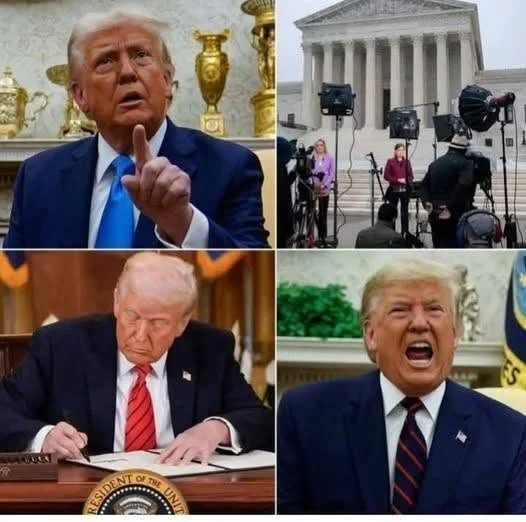
BREAKING NEWS: THE HEADLINE IS LOUDER THAN A FIRE ALARM,
THE INTERNET IS RUNNING ON COFFEE AND CAPITAL LETTERS, AND EVERYONE WANTS TO KNOW WHAT ACTUALLY HAPPENED!
Washington, D.C. — In a fictional scenario inspired by one of the internet’s most dramatic headline styles,
America has apparently entered another episode of political theater in which a court ruling is presented as a historic earthquake,
legal paperwork becomes a national thriller, and the phrase “7–2 DECISION” is enough to make social media behave as though somebody just switched off the electricity in the White House.
The headline practically screams from the screen:
“SUPREME COURT CRUSHES TRUMP OVERNIGHT — 7–2 RULING ERASES 30+ EXECUTIVE ORDERS!”
Thirty executive orders? Overnight?
Someone get the coffee machine ready.
Somebody alert the commentators. And please, for the love of constitutional law,
find the actual court opinion before the internet starts celebrating, panicking, or arguing about a decision nobody has bothered to read.
Because in modern political media, apparently, a legal document is no longer just a legal document.
It is a blockbuster movie.
And every headline writer wants to direct the sequel.
THE SUPREME COURT: WHERE BORING LEGAL WORDS BECOME INTERNET EXPLOSIONS
Imagine waking up early in the morning, reaching for your phone, and discovering that the Supreme Court has supposedly delivered
a decision so powerful that more than 30 executive orders have disappeared into the constitutional recycling bin.
You haven’t brushed your teeth yet.
You haven’t had breakfast.
But apparently, American constitutional history has already completed three seasons and released a dramatic finale.
One commentator is shouting, “THIS CHANGES EVERYTHING!”
Another is announcing, “WASHINGTON IS IN CHAOS!”
A third has uploaded a 52-minute video explaining how a single judicial ruling allegedly changes the entire political landscape.
And somewhere in the middle of all this excitement, a sensible person asks a remarkably inconvenient question:
“Can somebody show me the ruling?”
Silence.
A cough.
An awkward pause.
Then someone changes the subject to the reactions.
Welcome to the internet, where the reaction to a story sometimes becomes bigger than the story itself.
Of course, real Supreme Court decisions can have enormous consequences.
They can uphold laws, invalidate government actions, restrict executive authority, or reshape how constitutional powers are understood.
But the difference between a major legal development and a dramatic headline is that the former requires evidence, details, and context.
The latter requires a red arrow pointing toward Donald Trump’s face.
Preferably with flames in the background.
SEVEN TO TWO! THE MAGIC NUMBERS THAT SEND COMMENT SECTIONS INTO ORBIT
Let’s talk about those two numbers: 7–2.
In an actual Supreme Court decision, a 7–2 vote would mean seven justices joined one side of the decision and two took the opposing position.
The legal significance would depend on the case, the reasoning, and what the Court actually ordered.
But on social media?
Seven to two sounds like the final score of the biggest championship game in political history.
Imagine the imaginary sports commentator:
“LADIES AND GENTLEMEN, WE HAVE A FINAL RESULT! SEVEN JUSTICES ON ONE SIDE, TWO ON THE OTHER! THE CONSTITUTIONAL SUPER BOWL HAS OFFICIALLY BEGUN!”
The crowd goes wild.
Someone waves an American flag.
Someone else posts a photograph of the Supreme Court building with the words “GAME OVER.”
Meanwhile, actual lawyers are sitting at their desks trying to explain the difference between a court’s holding, its reasoning, the scope of an injunction, and the practical effect of a judgment.
Nobody clicks on the explanation.
The dramatic thumbnail has already won.
And somewhere, a legal scholar whispers into a coffee cup, “I spent seven years studying this subject for this?”
THIRTY EXECUTIVE ORDERS? SOMEBODY BETTER CHECK THE PAPERWORK!
Now we arrive at the headline’s most spectacular claim: more than 30 executive orders supposedly erased in one ruling.
Thirty!
That is enough paperwork to make an office printer file for retirement.
But what does “erased” actually mean?
Were the orders formally invalidated?
Were some provisions blocked? Did a court rule on one particular policy that appeared in multiple orders?
Was the decision limited to specific plaintiffs?
Or has a headline taken a complicated legal dispute and compressed it into six words designed to generate maximum excitement?
Those questions matter.
Executive orders do not all cover the same subject, and a court decision concerning one policy does not automatically cancel every other executive order issued by the same president.
The actual legal consequences depend on the case and the language of the judgment.
Yet the imaginary headline writer is not interested in such details.
“Thirty orders?” asks an editor.
“Yes!”
“Are all 30 actually covered by the ruling?”
“We need a headline by lunchtime!”
“Should we explain the legal scope?”
“Put CRUSHES in capital letters!”
And just like that, a potentially complicated constitutional dispute becomes a digital fireworks display.
The article may require ten paragraphs of legal analysis, but the headline has already delivered its verdict to millions of scrolling thumbs.
INSIDE THE WHITE HOUSE: A SATIRICAL SCENE NO ONE SHOULD MISTAKE FOR REAL NEWS
Let’s enter an entirely fictional White House scene.
The clock reads 7:03 a.m.
An imaginary adviser rushes into a meeting carrying a phone.
“Sir, there’s a headline!”
“What does it say?”
“Seven to two!”
“Seven to two what?”
“The Supreme Court!”
“What happened?”
“The internet says everything happened!”
The room falls silent.
Another adviser opens a laptop.
“Do we have the opinion?”
“Not in this group chat.”
“Has anyone checked the Court’s official website?”
“We’re still reading the comments.”
At that precise moment, a third adviser announces that the headline has already been shared thousands of times.
Everyone looks concerned.
Not necessarily because of the legal implications.
Because somebody has posted a meme, and it is now trending.
The fictional meeting descends into a debate about whether the administration should issue a statement,
whether the headline needs correcting, and whether the phrase “historic defeat” can be used before anyone establishes what the decision actually says.
Then someone asks the most important question of the morning:
“Can we at least find out what case this is about?”
Cut to black.
Dramatic music.
Coming next: The Search for the Missing Court Opinion.
SOCIAL MEDIA HAS ALREADY DELIVERED ITS VERDICT
The most entertaining part of an explosive political headline is often what happens in the comments.
One user writes:
“FINALLY! THIS IS HUGE!”
Another replies:
“THEY CAN’T DO THAT!”
A third declares:
“I KNEW THIS WAS COMING SIX MONTHS AGO!”
And a fourth asks:
“Which executive orders?”
The fourth user receives three angry replies, two laughing emojis, and a link to a video that does not answer the question.
Meanwhile, the self-appointed constitutional experts have arrived.
One has read the entire decision.
Another has read the first paragraph.
A third has read the headline and somehow reached a conclusion about the future of the republic.
And one particularly confident account begins its analysis with the words:
“I am not a lawyer, BUT…”
Those four words have launched more online legal debates than anyone can reasonably count.
Of course, social media can also help people discover important developments and access primary documents.
The problem is not that people discuss politics online.
The problem is that speed and certainty often travel together, even when the evidence has not caught up.
The result is a familiar spectacle: thousands of people debating the meaning of a ruling before establishing the case, the vote, or the actual remedy.
The comments section becomes a courtroom.
The algorithm becomes the judge.
And the person who has not opened the article becomes the lead prosecutor.
THE BREAKING-NEWS INDUSTRY’S FAVORITE INGREDIENT: DRAMA
Let’s give credit where it is due.
A headline such as “Supreme Court Issues Decision in Dispute Over Executive Authority” may be accurate, but it does not exactly sound like the trailer for a summer blockbuster.
Now compare that with:
“SUPREME COURT CRUSHES TRUMP OVERNIGHT!”
Suddenly, we have a villain, a dramatic confrontation, a ticking clock, and a promise of spectacular consequences.
Add “7–2 RULING” and “30+ EXECUTIVE ORDERS” and the story practically comes with its own movie soundtrack.
The formula is simple:
- Start with a powerful public figure.
- Add a court, Congress, or another institution.
- Introduce a dramatic verb such as “crushes,” “destroys,” or “obliterates.”
- Include a number that sounds precise.
- Add “overnight” to create urgency.
- Finish with an implication that history has changed forever.
Congratulations! You now have a headline engineered to stop people from scrolling.
But dramatic language is not a substitute for reporting.
A court ruling can be consequential without being a total victory for one side. It can reject one argument while accepting another.
It can resolve a narrow legal question while leaving larger disputes untouched.
Real law is complicated.
The internet wants a knockout punch.
And that tension is precisely why readers should look beyond the headline.
THE REAL STORY IS IN THE DETAILS
For anyone who wants to determine whether this particular claim is genuine, there are several important questions to answer.
First: Which case produced the alleged 7–2 ruling?
A credible report should identify the case name, the date of the decision, and the issue before the Court.
Second: What did the justices actually decide?
A headline might describe a loss for a president, but the written opinion determines which arguments succeeded, which failed, and why.
Third: Were 30 or more executive orders actually affected?
That requires specific evidence. A broad claim about dozens of orders should identify the relevant orders or explain precisely how the judgment affects them.
Fourth: What is the scope of the remedy?
A court might block a particular action, invalidate a specific provision, or issue a ruling with broader consequences. Those outcomes are not interchangeable.
Finally: Is the report supported by reliable sources?
The Supreme Court’s official website publishes its opinions and orders, making it a useful starting point for verifying a claim of this magnitude.
The distinction is important: a headline can be emotionally satisfying, politically frustrating, or spectacularly entertaining without accurately describing what happened.
And the Constitution, unfortunately for headline writers, does not operate according to thumbnail design.
POLITICS IS NOT A FOOTBALL SCOREBOARD
There is another reason to approach this kind of headline carefully.
American government is built around institutions with different responsibilities and competing legal authorities.
The president exercises executive power, Congress legislates, and the judiciary resolves legal disputes within its jurisdiction.
When those institutions disagree, the consequences can be significant.
But a court decision is not automatically equivalent to a political team winning the Super Bowl.
A ruling may constrain executive authority in one area while leaving other powers untouched.
A president may lose a particular legal argument and still retain substantial authority elsewhere.
The government may also have options available through further litigation, revised policies, or other lawful processes, depending on the circumstances.
None of that makes a decision unimportant.
It simply means that understanding the decision requires more than a victory banner and a dramatic soundtrack.
Democracy benefits when citizens understand what their institutions actually do, what legal decisions mean, and where the limits of those decisions lie.
That is much more useful than treating every political development as the final episode of a never-ending reality show.
Although, admittedly, the reality show’s ratings would probably be enormous.
THE INTERNET’S NEXT HEADLINE IS ALREADY WRITING ITSELF
If the internet continues using the same dramatic formula, we can already imagine the next fictional headlines:
“CONGRESS BLINKS TWICE — WASHINGTON IN TOTAL DISBELIEF!”
“FEDERAL JUDGE SIGNS DOCUMENT — POLITICAL ESTABLISHMENT ENTERS UNCHARTED TERRITORY!”
“SUPREME COURT RELEASES 40-PAGE OPINION — INTERNET EXPERTS REACH CONCLUSIONS AFTER READING THE TITLE!”
And the inevitable sequel:
“LAW PROFESSORS ISSUE CALM, NUANCED EXPLANATION — NOBODY CLICKS!”
The satire practically writes itself.
A government institution performs its ordinary function, and the internet turns it into an apocalypse.
A legal dispute continues through the courts, and social media declares the matter permanently settled.
A decision addresses a specific issue, and a headline claims the entire political system has been transformed overnight.
Meanwhile, the actual documents sit quietly on an official website, waiting for someone to read them.
Perhaps the most revolutionary act on the internet today is not sharing the loudest headline.
It is opening the source.
FINAL WORD: DID THE COURT REALLY ERASE 30+ EXECUTIVE ORDERS?
Here is where the comedy must give way to the facts.
The headline alone does not establish that the Supreme Court issued a 7–2 ruling invalidating more than 30 executive orders overnight.
Without a matching case, official opinion, or reliable report documenting those specific claims, they should not be presented as confirmed news.
The Supreme Court does issue consequential decisions involving presidential authority. Those decisions deserve serious attention, careful reporting, and scrutiny of their legal reasoning.
But the specific claim in this headline requires verification.
Until the case and its actual outcome are established, the safest interpretation is that this is an unverified, highly sensationalized claim—not a confirmed account of a sweeping judicial decision.
And if the headline turns out to be exaggerated, the internet will have to face a truly devastating development:
Somebody may have clicked on a political story expecting a constitutional earthquake and discovered that the first thing requiring an emergency response was the headline itself.
BREAKING SATIRICAL UPDATE: The comment section remains open.
The capital letters remain enormous. The imaginary newsroom has ordered another pot of coffee. And somewhere, a reader is still asking the question that started this entire adventure:
“Okay, but what does the actual ruling say?”
That reader deserves a raise.
DISCLAIMER: This article uses satire to comment on sensational political headlines.
The imagined scenes, dialogue, and newsroom reactions are fictional.
The alleged 7–2 ruling and cancellation of more than 30 executive orders have not been established by the headline itself and should not be treated as verified facts.