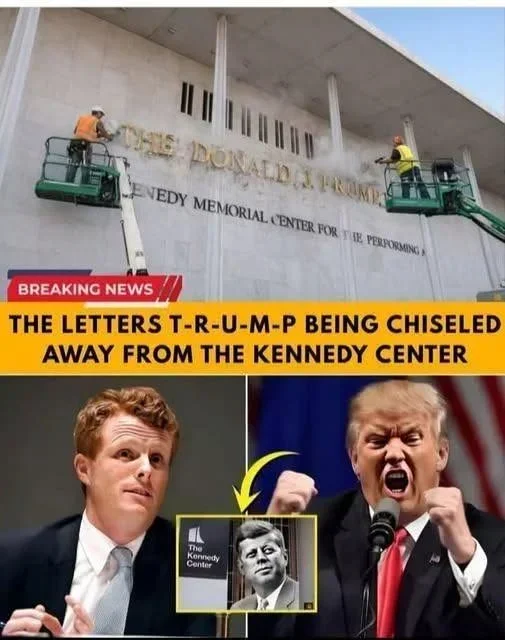
The John F. Kennedy Center for the Performing Arts has become a powerful symbol in the ongoing political and cultural battles surrounding Donald Trump.
What was once widely recognized as a prestigious home for music, theater, dance, and artistic expression has
increasingly found itself caught in the middle of a national debate over politics, leadership, and the role of government in American culture.
The provocative headline, “The Trash Has Been Collected,” captures the anger of critics who believe
Trump’s influence over the institution represented an unwelcome intrusion into a place meant to celebrate artistic excellence.
For those opponents, the controversy is about far more than a name on a building or a change in leadership.
It reflects a broader struggle over whether America’s cultural institutions should serve as independent spaces for creativity or become extensions of partisan political power.
A Cultural Institution at the Center of Political Conflict
The Kennedy Center occupies a special place in American cultural life.
Established as a living memorial to President John F. Kennedy, it has hosted celebrated performers, orchestras, theatrical productions, and major national events for decades.
Its mission has traditionally emphasized the performing arts and their ability to bring people together across differences.
However, the institution has increasingly become a subject of political controversy as debates about its leadership, programming, and relationship with the federal government have intensified.
Trump’s involvement with the Kennedy Center generated strong reactions from supporters and opponents alike.
Critics argued that his approach risked politicizing an institution whose reputation depends on artistic independence and public trust.
Supporters, meanwhile, defended his involvement as an effort to change its direction and challenge what they viewed as entrenched cultural establishment practices.
These competing interpretations reveal how even a major arts institution can become a battleground for America’s wider political divisions.
Why Trump’s Influence Sparked Such Strong Reactions
For many critics, the central concern was not simply that a president had become involved in a cultural institution.
Rather, it was the possibility that political loyalty could begin to overshadow artistic judgment.
The Kennedy Center’s reputation rests on its ability to attract outstanding performers, welcome diverse audiences, and maintain credibility beyond the political disagreements of the moment.
When its leadership or public image becomes closely associated with a single political figure, questions naturally arise about its independence.
Opponents of Trump have argued that his involvement threatened to transform the center into another arena for partisan conflict.
They worry that artists, donors, audiences, and cultural organizations could feel pressure to choose sides rather than focus on the work that brings them together.
Trump’s supporters reject that interpretation, arguing that leadership changes can be legitimate and that cultural institutions should not be shielded from scrutiny simply because of their historical prestige.
The disagreement illustrates a fundamental question: Who should shape the future of America’s most prominent cultural institutions, and how can those institutions preserve public confidence while responding to changing political leadership?
The Kennedy Center’s Name and Legacy
The Kennedy Center’s connection to John F. Kennedy is central to its identity. Its name honors a president whose administration emphasized public service, international cultural exchange, and the importance of the arts in American life.
That history makes controversies surrounding the center especially sensitive.
For many Americans, the institution represents a national cultural legacy that should rise above the personalities and political battles of any single administration.
The debate over Trump’s influence therefore extends beyond personal approval or disapproval of the former president.
It raises questions about tradition, institutional continuity, and the responsibilities of those entrusted with overseeing nationally significant organizations.
Critics see the controversy as a warning about the risks of politicizing cultural spaces.
Supporters see it as part of a broader struggle over who gets to define American culture and whose values receive recognition.
Both sides understand that the institution carries symbolic weight far beyond its stages and concert halls.
A Divided Audience Reacts
The controversy has also generated sharply divided reactions among audiences and political observers.
Trump’s critics have welcomed developments they interpret as a retreat from his influence, viewing them as opportunities to restore a greater emphasis on artistic independence.
For some, the language of removing a “stain” reflects frustration with what they consider the unnecessary politicization of a respected cultural institution.
Trump’s supporters, however, may view the same developments as an attack on a leader whose policies and appointments they support.
They argue that changes in leadership and institutional direction are not automatically evidence of wrongdoing.
The resulting debate demonstrates how difficult it has become for major American institutions to avoid being interpreted through a partisan lens.
Yet the long-term success of the Kennedy Center will ultimately depend on more than political victories or defeats.
Its reputation will be shaped by the quality of its performances, the artists it welcomes, the audiences it serves, and its ability to maintain public confidence.
What Comes Next for the Kennedy Center?
The institution’s future will depend on how its leadership navigates the competing expectations of artists, audiences, donors, policymakers, and the wider public.
Restoring confidence requires more than symbolic changes.
It requires transparent decision-making, a clear commitment to artistic excellence, and an environment in which creative work can thrive without being reduced to a political loyalty test.
The Kennedy Center also faces a broader challenge shared by many cultural organizations: finding ways to serve a diverse public in an increasingly polarized country.
Its greatest contribution may come from providing a place where people with different backgrounds and political beliefs can experience music, theater, dance, and other art forms together.
Whether the latest developments ultimately strengthen the institution will depend on the decisions that follow and on whether the center can maintain its cultural mission through a period of intense political disagreement.