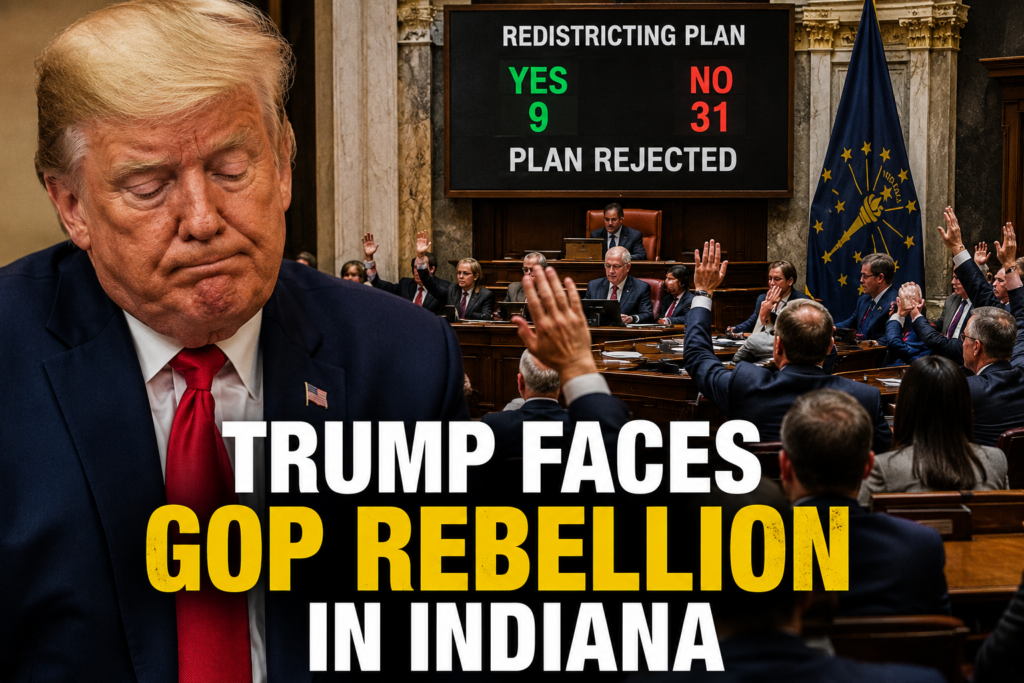
Trump Faces GOP Rebellion in Indiana
Donald Trump has once again found himself at the center of a heated political debate after lawmakers in Indiana rejected a proposal that supporters believed would reshape the state’s congressional map. The decision quickly sparked reactions across the political spectrum, with many commentators describing it as one of the most notable moments of internal Republican disagreement in recent months.
While Indiana has long been considered a Republican-leaning state, the outcome of the vote demonstrated that not every issue receives unanimous support within the party. The debate centered on questions of redistricting, legislative independence, and the balance of power between elected officials and party leadership.
What Was the Proposal?
The proposal involved changes to congressional district boundaries, commonly known as redistricting. Supporters argued that updating district maps is a routine part of the political process and can better reflect changes in population and representation.
Critics, however, expressed concerns that the proposed changes could favor one political party over another. Several lawmakers argued that any redistricting effort should remain transparent and prioritize fair representation rather than political advantage.
As the debate intensified, attention quickly shifted beyond the proposed maps themselves and toward the broader political implications.
A Surprising Vote
When the final vote was held, the proposal failed by a wide margin. Several Republican senators joined others in opposing the measure, creating an unexpected bipartisan outcome.
Political observers described the vote as significant because it highlighted differing opinions within the Republican Party itself. Rather than following a single political direction, lawmakers appeared willing to vote according to their own views on the issue.
The result immediately became national news, with many analysts suggesting it reflected the growing independence of some state legislators.
Trump’s Response
Following the vote, Donald Trump publicly criticized the decision and voiced disappointment with lawmakers who opposed the proposal.
Supporters of the former president argued that the plan would have strengthened Republican representation in future elections. Others maintained that the state legislature had every right to make its own independent decision without outside pressure.
As with many high-profile political debates, reactions varied widely depending on political perspective.
Why This Matters
Redistricting has become one of the most closely watched issues in American politics. Every decade, following the U.S. Census, states review congressional district boundaries to account for population changes.
These decisions can influence future elections by determining how communities are grouped into voting districts. Because of this, both major political parties often pay close attention to redistricting proposals.
Supporters generally argue that map adjustments ensure equal representation, while critics warn that overly partisan district lines can reduce electoral competitiveness.
Reactions Across the Political Landscape
The Indiana vote generated immediate responses from elected officials, political commentators, and advocacy groups.
Some praised lawmakers for demonstrating legislative independence and placing constitutional principles ahead of political pressure. Others argued that the proposal deserved greater consideration and believed it could have benefited Republican candidates in future elections.
Political analysts also noted that disagreements within parties are not unusual and often reflect the diverse viewpoints held by individual legislators.
The Bigger Picture
The debate extends beyond one state or one proposal. Across the United States, questions about election laws, district boundaries, and voting representation continue to shape political conversations.
Both Republicans and Democrats have supported or opposed various redistricting efforts depending on the circumstances in different states. As a result, disputes over district maps remain one of the most contested issues in American politics.
The Indiana vote has become another example of how state legislatures can influence national political discussions.
Looking Ahead
Although this particular proposal was rejected, conversations about redistricting are unlikely to end. Lawmakers may introduce revised proposals in the future, while courts and election officials continue reviewing similar issues across the country.
Political observers expect debates over representation, election fairness, and legislative authority to remain major topics as future elections approach.
Final Thoughts
The Indiana Senate’s decision represents an important moment in an ongoing national conversation about political representation and legislative independence. Whether viewed as a setback, a victory for institutional checks and balances, or simply part of the democratic process, the vote has drawn attention to the complex relationship between party leadership and elected lawmakers.
As future legislative sessions unfold, the outcome in Indiana may continue to serve as a reference point in broader debates over redistricting, state authority, and the evolving dynamics within American politics.