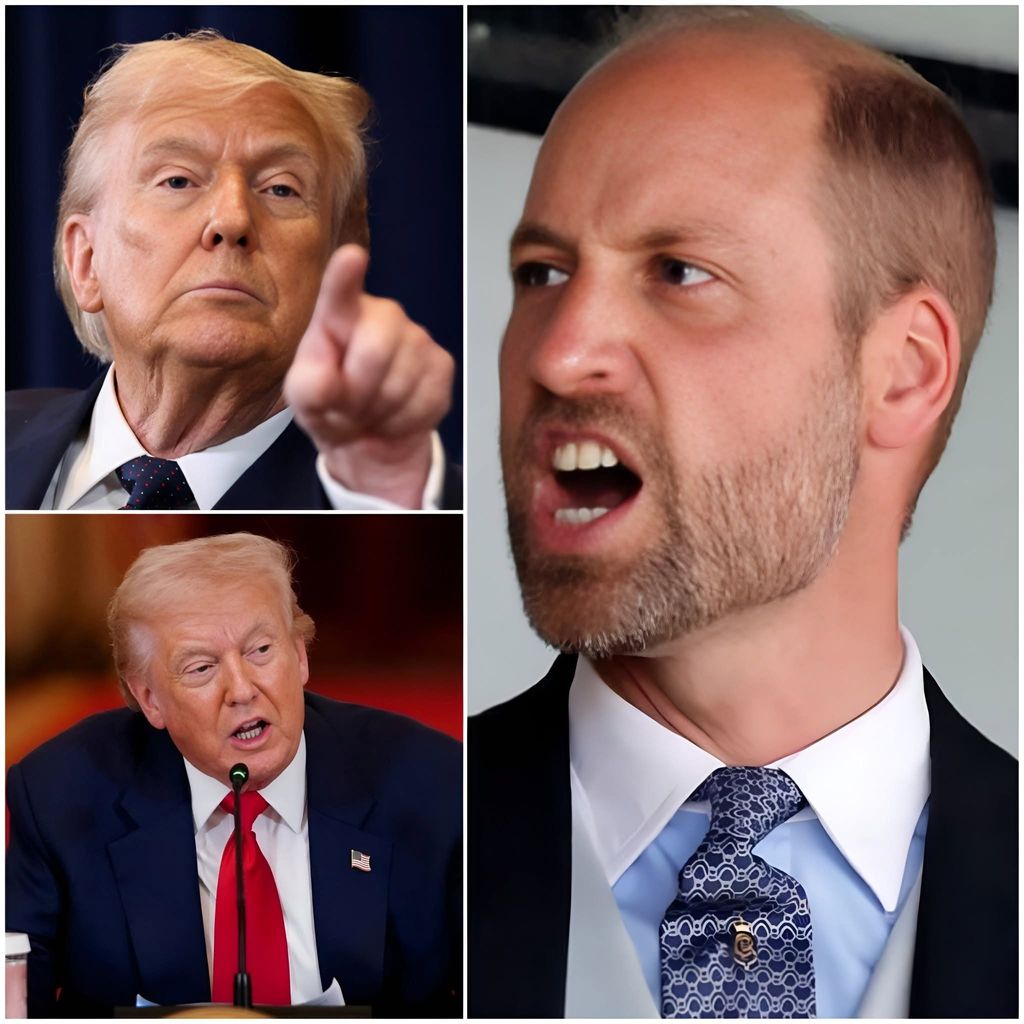
The post arrived with all the force of breaking news:
Prince William had supposedly abandoned royal restraint,
denounced President Donald Trump and warned Americans to “wake up before it’s too late.”
Social media accounts declared that Washington was in chaos.
Yet behind the capital letters, dramatic quotations and promises of political upheaval,
one crucial element was missing: evidence that the Prince of Wales had said any of it.
For a few breathless minutes, the story seemed enormous enough to alter the relationship between Britain and the United States.
Prince William, the normally restrained heir to the British throne,
had allegedly thrown aside generations of royal protocol and stepped directly into America’s political conflict.
He supposedly described President Donald Trump as “a self-serving showman,”
warned the United States to “wake up before it’s too late” and declared
that Trump was precisely why constitutional safeguards and accountability existed.
Then came the line designed to travel furthest:
“We don’t need kings. We need leaders who care about the truth and the people they serve—as well as the future of this planet.”
According to the posts, the internet erupted within minutes.
Supporters celebrated. Critics were stunned.
Washington descended into turmoil as political programs and newsrooms rushed to respond.
It sounded like a constitutional earthquake.
But where had William spoken?
At a charity event?
During a television interview?
In a written statement from Kensington Palace?
Before a university audience?
At an environmental conference?
The viral posts did not say.
They provided no date, no venue, no complete video, no official transcript and no named journalist who had witnessed the remarks.
Searches for the exact quotations led primarily to Facebook groups, Instagram posts, forums and low-credibility websites repeating the same wording.
The official Royal Family website contained no such statement.
Reputable international news organizations did not report William making it.
No evidence emerged from Kensington Palace or the Prince and Princess of Wales’s official communications.
As of September 16, 2026, there is no credible basis for presenting these remarks as authentic.
Prince William did not “set Washington on fire” with the quoted denunciation.
The available evidence indicates that social media created the explosion—and then used the size of that explosion as supposed proof that the event had happened.
A royal intervention that would have been impossible to overlook
If the heir to the British throne publicly condemned a sitting American president in such personal terms, it would not remain confined to a handful of social-media pages.
The remarks would immediately become a major diplomatic story.
The White House would face questions.
Downing Street would likely be pressed for a response.
Buckingham Palace and Kensington Palace would confront demands for clarification.
British constitutional experts would debate whether William had jeopardized the monarchy’s political neutrality.
Major newspapers and broadcasters on both sides of the Atlantic would publish the video, transcript and context.
None of that occurred.
Instead, the statement appeared as a free-floating block of dramatic text.
Some versions obscured Trump’s name with punctuation, writing it as “D.o.n.a.l.d T.r.u.m.p”—a common tactic used by engagement-driven pages attempting to avoid moderation systems or manipulate distribution.
The posts described public reaction without identifying anyone who had actually reacted.
Washington was supposedly “shaking,” yet no lawmaker, administration official or diplomatic representative was quoted.
Political roundtables were said to be consumed by the story, but no program or broadcaster was named.
The language offered the appearance of reporting without the basic components of a report.
A genuine news article answers where, when and how. A viral script asks only how strongly the reader can be made to feel.
Why the alleged words would represent a royal rupture
The British monarchy operates through a carefully maintained separation from partisan politics.
The official Royal Family website explains that the sovereign acts as head of state while remaining politically neutral.
The monarch may privately “advise and warn” the prime minister, but those conversations remain confidential.
The wider working Royal Family supports the sovereign through constitutional, diplomatic and charitable duties shaped by that same tradition of restraint. The Royal Family: the Sovereign and the Prime Minister
Prince William is not yet the monarch, but as heir to the throne, his public words carry constitutional and diplomatic weight.
He can speak about homelessness, mental health, conservation and environmental responsibility.
He can advocate for causes without endorsing a political party or instructing voters how to judge a particular candidate.
Calling an American president a “self-serving showman” would cross into something fundamentally different.
It would be a personal political attack on the elected leader of one of Britain’s closest allies.
It would risk dragging the Crown into an American partisan struggle and potentially complicating the British government’s foreign policy.
The line “We don’t need kings” would be especially implausible coming from a man whose public role depends upon hereditary monarchy.
It might sound powerful inside an American political slogan, but it would raise obvious questions if spoken by Britain’s future king.
That contradiction is one of the story’s clearest warning signs.
The statement sounds less like the language of Prince William and more like American anti-authoritarian rhetoric placed in the mouth of a famous royal figure to give it greater dramatic force.
What William has actually done when Trump became controversial
The absence of the viral quotation does not mean there have been no tensions surrounding Donald Trump and members of the Royal Family.
Trump’s statements about Britain, NATO, the war in Ukraine, Prince Harry and Meghan have repeatedly generated headlines.
Members of the Royal Family have sometimes found themselves near political controversy even while attempting to remain above partisan conflict.
But the verified pattern is markedly different from the viral story.
William met Trump in Paris in December 2024 during ceremonies marking the reopening of Notre-Dame Cathedral. The two spoke at the British ambassador’s residence.
Trump later characterized the conversation positively and said they had discussed the health of King Charles and Catherine,
Princess of Wales. There was no public denunciation from William. ABC News report on the Paris meeting
More recently, reports concerning royal reactions to Trump-related controversies have emphasized private diplomacy and restraint rather than explosive public attacks.
One account in early 2026 specifically noted that William chose to remain silent while concerns about comments involving British service members were reportedly conveyed through other channels.
During King Charles’s 2026 visit to the United States,
the monarch addressed Congress and emphasized NATO, support for Ukraine and the dangers of isolationism.
Those carefully framed themes carried diplomatic meaning without turning into a personal attack on the president.
That is how modern royal diplomacy normally operates: through language chosen to express principles while avoiding direct participation in party warfare.
The difference between environmental advocacy and electoral politics
Part of the fabricated statement may seem believable because William has spoken consistently about the environment.
Through the Earthshot Prize and other initiatives, he has promoted innovation addressing climate change, pollution, biodiversity loss and environmental degradation.
He has used royal visibility to bring attention to scientists, entrepreneurs and community leaders developing practical solutions.
Those efforts inevitably touch subjects affected by public policy.
But advocating for clean air or conservation is not the same as publicly telling another country that its president is a dangerous showman.
Royal figures generally frame such causes around shared responsibility, long-term stewardship and cooperation rather than partisan instruction.
The invented quotation blurs that distinction. It attaches a genuine part of William’s public identity—concern for the planet—to language he is not documented as having used.
That mixture makes the story more convincing.
Effective misinformation often contains a recognizable truth. William genuinely cares about environmental issues.
He genuinely speaks about future generations. He genuinely occupies a position associated with restrained diplomacy.
The fabrication takes those authentic elements and adds the confrontation audiences are primed to share.
Why people wanted to believe the statement
The viral post did not spread because every reader had studied the British constitution or followed Kensington Palace’s announcements.
It spread because it offered emotional satisfaction.
Many opponents of Trump long to see an internationally respected figure express their fears in simple, uncompromising language.
A prince denouncing presidential overreach creates an irresistible reversal: a representative of monarchy warns a republic against king-like power.
The symbolism is powerful.
At the same time, Trump’s supporters can share the post in outrage, using it as evidence of foreign elites interfering in American democracy.
The story therefore generates engagement from both sides. One group celebrates; the other condemns. Both expand its reach.
This is the ideal architecture for viral misinformation.
It does not require universal belief. It requires emotional participation.
The words “Washington is shaking” also give readers the feeling that they are witnessing a historic event before traditional media has caught up.
Anyone who shares the post becomes part of breaking the news.
But urgency is often the enemy of verification.
When a claim encourages immediate reaction while withholding basic sourcing, the wisest response is not applause or anger.
It is a request for the original footage.
“Millions agree” is not evidence
Viral posts frequently use public reaction as a substitute for proof.
They say the internet “exploded,” viewers were “stunned” or political leaders were “terrified.” These descriptions create social validation.
If millions are reacting, the reader assumes there must be a real event beneath the reaction.
But a false claim can generate genuine outrage.
The reaction proves only that people encountered the claim, not that the claim is accurate.
In this case, accounts repeated nearly identical language.
The same quotations appeared across multiple pages without attribution.
Duplication created the illusion of confirmation, even though the posts may have originated from a single unverified source or copied one another.
Ten websites repeating one unsupported statement do not constitute ten independent sources.
Credible confirmation requires separate reporting based on identifiable evidence: an official transcript, a full recording, a named witness or acknowledgment from the speaker’s representatives.
Without that foundation, virality is merely volume.
The constitutional irony hidden inside the invented quotation
The false statement invokes “constitutional safeguards and accountability,” concepts essential to democratic government.
Yet the post itself avoids a basic form of accountability: identifying where its information came from.
That irony should not be ignored.
Healthy democracy depends on the ability to criticize presidents, governments and institutions.
Donald Trump, like every public official, can be scrutinized for his policies, statements and exercise of power. Citizens and journalists do not need royal permission to conduct that scrutiny.
But criticism becomes weaker when it relies on fabricated endorsements.
If someone believes constitutional limits are under threat, that argument should be made with laws, court decisions, documented actions and verifiable quotations.
Inventing support from Prince William may produce immediate traffic, but it gives opponents an easy reason to dismiss the larger concern.
False evidence does not strengthen a true principle.
It contaminates it.
A public committed to accountability must also hold its preferred stories accountable.
How to recognize a manufactured political quotation
The Prince William post contains several common warning signs.
First, it uses sensational language before providing any evidence. “BOOM,” “Washington is shaking” and “the internet erupted” tell readers what emotion to feel before establishing what happened.
Second, it presents multiple polished quotations without a source.
There is no speech, interview, date, venue or recording.
Third, it describes unnamed reactions. Supporters cheered, critics were stunned and Washington fell into chaos—but no identifiable person is quoted responding.
Fourth, the language fits the desires of a political audience more closely than the documented speaking style of the person to whom it is attributed.
Finally, the alleged statement would represent a massive departure from royal protocol, yet no credible diplomatic or political institution appears to have noticed.
Any one of these signs should encourage caution. Together, they make the story untenable without substantial new evidence.
Political neutrality does not mean moral emptiness
It is reasonable to ask whether royal neutrality prevents meaningful leadership.
William has inherited a role in which every public sentence is examined for political implications.
Remaining neutral can appear frustrating, especially during moments when citizens want influential figures to take sides.
But constitutional restraint is not necessarily the absence of values.
Members of the Royal Family can speak about service, environmental responsibility, mental health, homelessness and social cohesion.
They can meet people whose experiences reveal failures in society.
They can encourage institutions to act without endorsing a party or attacking an elected leader.
That balance is imperfect and frequently debated. Critics of monarchy may question whether hereditary public influence belongs in a modern democracy at all.
Supporters may argue that political neutrality allows the Crown to represent continuity above electoral conflict.
Those are legitimate arguments.
They should be conducted openly, not through imaginary declarations.
Prince William’s actual public role is complicated enough without transforming him into a partisan character written for social media.
What responsible publishers should do
A dramatic political claim should not be posted as news merely because it produces engagement.
Before publication, editors should search the exact quotation, inspect official channels, identify the original video and compare reporting from multiple credible organizations.
If the statement cannot be verified, the headline must not present it as established fact.
Publishers still have compelling options.
They can write a fact-check explaining how the rumor spread.
They can analyze why the quotation appealed to readers.
They can examine the constitutional limits surrounding royal political speech.
They can compare the invented statement with William’s documented environmental advocacy and diplomatic conduct.
The result may be more interesting than the fabricated confrontation.
Instead of asking, “Why did William attack Trump?” readers confront a larger mystery:
Who wrote the quotation, why did it spread so quickly, and why were so many people willing to believe that a future British king had suddenly entered America’s political war?
That is a real story.
The truth behind the explosion
Prince William has not been shown to have called Donald Trump “a self-serving showman.”
There is no verified evidence that he told Americans to “wake up before it’s too late.”
There is no authenticated speech in which he said Trump demonstrated the need for constitutional safeguards.
There is no credible record of him declaring, “We don’t need kings.”
Washington was not thrown into chaos by these alleged remarks.
Social media was stirred by an unsupported text post crafted to look like breaking news.
The distinction matters because false quotations do more than mislead.
They place public figures inside conflicts they did not enter, distort diplomatic relationships and condition audiences to respond emotionally before checking the record.
The deeper message is not that people should stop criticizing power.
It is that criticism must become more disciplined.
Ask for evidence. Search for the complete speech. Verify the date and location.
Notice when every dramatic reaction is anonymous.
Refuse to let agreement with a quotation become proof that the speaker uttered it.
Democracy needs accountability, but accountability begins with facts.
Prince William’s imaginary warning may have been written to make readers believe that one courageous sentence could shake Washington.
The real act of courage is quieter.
It is pausing before sharing.
It is choosing truth over emotional convenience.
And it is refusing to place words in another person’s mouth—even when those words say exactly what we wanted to hear.