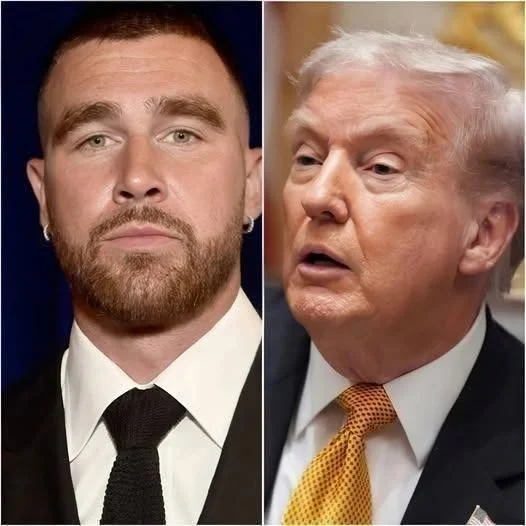
BREAKING NEWS: A Football Star Exists, the Internet Loses Its Mind, and Washington Allegedly Needs an Emergency Meeting!
In a shocking development that absolutely nobody should take seriously,
NFL superstar Travis Kelce has supposedly sent the internet into a state of total chaos,
leaving political commentators confused, social media users screaming, and Washington wondering whether it needs to issue an official statement.
At least, that is what the headline would have you believe.
Because apparently, in today’s world, a celebrity does not even need to throw a football, score a touchdown, or say anything particularly controversial to trigger a digital earthquake.
Sometimes, all it takes is a dramatic headline, three exclamation marks, and somebody on the internet typing the words “WASHINGTON IS SHAKING” in capital letters.
And BOOM!
Suddenly, everybody is an expert.
THE INTERNET HAS ENTERED EMERGENCY MODE
The moment a headline featuring Travis Kelce and Washington appears on the internet, the imaginary emergency sirens begin ringing.
News commentators are adjusting their microphones. Social media influencers are preparing their reaction videos. Podcast hosts are clearing their schedules.
Somewhere, a man who has never watched a complete NFL game is preparing a 45-minute analysis of what this means for the future of America.
“Folks, this changes EVERYTHING!” he announces dramatically.
What changes?
Nobody knows.
Has Kelce announced a revolutionary new football strategy? Has he challenged the entire political establishment to a game of catch? Has he suggested that Congress settle its disagreements with a two-minute drill?
We have no idea.
But the thumbnail has a giant red arrow pointing at his face, the background is glowing orange, and the word EXPLOSIVE is written in a font large enough to be visible from space.
Clearly, this is serious business.
TRAVIS KELCE: TIGHT END BY PROFESSION, INTERNET SUPERWEAPON BY ACCIDENT
Let’s be honest: Travis Kelce is a major NFL star. He has earned his reputation through years of football, big performances, and his role with the Kansas City Chiefs.
But somewhere along the way, the internet decided that being a successful athlete was not enough.
Now, apparently, every movement deserves a national debate.
Kelce smiles? BREAKING NEWS.
Kelce frowns? BODY LANGUAGE EXPERTS ARE CONCERNED.
Kelce posts a photograph? SOCIAL MEDIA IS EXPLODING.
Kelce eats lunch? SOURCES CLAIM A MAJOR DEVELOPMENT IS UNFOLDING.
Kelce orders a cheeseburger without pickles? WASHINGTON DEMANDS ANSWERS.
At this rate, the man could sneeze during a press conference and somebody would publish an article titled:
“TRAVIS KELCE’S THREE-SECOND SNEEZE JUST CHANGED THE NFL FOREVER — WHAT HE DOES NEXT WILL SHOCK YOU!”
And the funniest part?
Millions of people would click it.
Some would share it without reading it. Others would argue about it in the comments. A few would insist that the sneeze was a carefully calculated strategic maneuver.
Welcome to the internet, where a normal Tuesday can become a global conspiracy by lunchtime.
WHY IS WASHINGTON ALWAYS “SHAKING”?
Here is a mystery worthy of its own investigation: Why does every sensational headline insist that Washington is shaking?
Washington is a city. It contains government buildings, offices, traffic, restaurants, and people who probably just want to finish their workday and go home.
Yet online headlines treat the entire city like a giant washing machine whenever a celebrity does something remotely interesting.
A football player makes a comment?
Washington is shaking.
An actor changes their hairstyle?
Hollywood is in panic.
A singer cancels a performance?
The music industry is trembling.
Someone buys a new pair of shoes?
The global fashion establishment is reportedly holding emergency talks.
At this point, Washington probably needs a full-time public relations department dedicated to issuing statements such as:
“We would like to clarify that the city is physically stable. No buildings are shaking. The coffee machines remain operational. Government business will continue as scheduled.”
Of course, that statement would immediately generate another headline:
“WASHINGTON RESPONDS TO KELCE CONTROVERSY — OFFICIALS FINALLY BREAK THEIR SILENCE!”
And just like that, the cycle begins again.
SOCIAL MEDIA INVESTIGATORS ARE ON THE CASE
The internet detectives are already warming up their keyboards.
One person posts: “Something BIG is happening!”
Another replies: “I knew this was coming!”
A third writes: “Nobody is talking about the real story!”
And someone with a profile picture of a cartoon eagle confidently declares: “Wake up, people!”
Wake up to what?
Nobody has explained that part.
Meanwhile, an account with 47 followers uploads a 12-second clip with dramatic music and the caption:
“TRAVIS KELCE JUST SENT A MESSAGE. YOU NEED TO WATCH UNTIL THE END.”
The clip ends before the message is explained.
The creator has successfully transformed absolutely nothing into a cliffhanger.
Hollywood screenwriters are taking notes.
But the internet keeps watching because curiosity is powerful, outrage is contagious, and the possibility of exclusive information is practically irresistible.
One person clicks. Ten people share. A hundred people comment. And suddenly, an ordinary moment has become a digital event with a life of its own.
The algorithm does not care whether the story is important.
It cares whether people stop scrolling.
THE CELEBRITY NEWS INDUSTRIAL COMPLEX
Let’s imagine the imaginary newsroom responsible for this masterpiece of breaking journalism.
An editor rushes into the room.
“Team! We need a headline that gets attention!”
A reporter raises a hand.
“Do we have confirmed information?”
The editor pauses.
“We have a photograph of Travis Kelce.”
“Anything else?”
“An internet rumor.”
“Has anyone verified it?”
“Not yet.”
The editor slowly stands up, looks out the window, and whispers:
“Make the headline say Washington is shaking.”
Five minutes later, the headline is live.
Ten minutes later, somebody has reposted it.
Twenty minutes later, a reaction channel has uploaded a video titled “MY HONEST THOUGHTS.”
Thirty minutes later, another account claims the first account is hiding important details.
And by the end of the day, a story that began with very little information has generated enough online discussion to fill an entire stadium.
The only person who has not been consulted is Travis Kelce himself.
He may simply be going about his day, completely unaware that the internet has assigned him the starring role in a political thriller he never auditioned for. WHAT IF KELCE REALLY DID NOTHING?
This is perhaps the funniest possibility of all.
Imagine that there is no dramatic announcement. No shocking political declaration. No secret meeting. No explosive confrontation.
Imagine that Travis Kelce simply woke up, checked his phone, ate breakfast, and went about his business.
Meanwhile, somewhere online:
“THE SILENCE IS DEAFENING!”
“WHY HAS HE NOT RESPONDED?”
“WHAT IS HE WAITING FOR?”
“THE NEXT 24 HOURS COULD CHANGE EVERYTHING!”
Perhaps he is waiting for his coffee to cool down.
Perhaps he has a football workout.
Perhaps he has absolutely no idea that a website has turned his ordinary morning into a national mystery.
But the headline must continue.
The drama must escalate.
And the audience must be persuaded that the next paragraph contains information that will change the course of human civilization.
Spoiler alert: It might just contain another paragraph about how the internet is reacting to the previous paragraph about the internet reacting.
It’s a never-ending loop of digital drama.
THE REAL WINNER? THE ALGORITHM.
While everyone argues about what a celebrity supposedly said, the algorithm sits quietly in the corner, counting clicks.
It does not care whether the headline is accurate, exaggerated, confusing, or completely ridiculous. What matters is engagement.
Did people click?
Did they comment?
Did they share the post with a friend and write, “Bro, look at this!”?
Did they argue about it for three hours?
Congratulations. The content has achieved its mission.
The headline does not necessarily need to deliver a shocking revelation. It only needs to create the expectation of one.
And that is why sensational phrases such as “BREAKING THE INTERNET,” “WASHINGTON IN PANIC,” and “EVERYONE IS TALKING” have become so familiar.
They turn curiosity into clicks and uncertainty into entertainment.
The audience arrives expecting an earthquake.
Sometimes, all it finds is a man holding a microphone.
A SMALL DOSE OF REALITY IN A VERY DRAMATIC WORLD
Of course, satire aside, public figures can influence conversations beyond their professional fields. Athletes have enormous audiences, and their statements can attract attention from fans, journalists, and political commentators.
But there is a difference between a genuinely significant development and a headline designed to make an ordinary event sound historic.
Before believing that a celebrity has triggered a political crisis, it helps to ask three simple questions:
- What exactly happened?
- Is there a reliable source confirming it?
- Does the article provide evidence, or does it simply repeat dramatic language?
If the headline promises a revolution but the article provides no verifiable details, a healthy dose of skepticism is appropriate.
Not every viral post is false. Not every dramatic headline is misleading. But the level of excitement in a headline is not proof that the underlying story is important or even accurate.
Sometimes, the biggest revelation is discovering that there was no revelation in the first place.
FINAL VERDICT: SOMEBODY PLEASE CHECK ON WASHINGTON!
As this entirely satirical investigation comes to an end, we can only hope that Washington has recovered from its alleged trembling.
The buildings are standing. The streets are still there. The internet remains operational. And Travis Kelce is still an NFL superstar, whether or not a sensational headline declares him the most powerful man on the planet today.
The real MVP of this imaginary crisis is the headline writer who managed to combine football, politics, suspense, and three exclamation marks into one irresistible package.
Somewhere, a click counter is celebrating.
Somewhere else, a social media user is typing, “I KNEW IT!”
And somewhere in Washington, a person is probably asking the most reasonable question of all:
“Wait a minute. What exactly happened?”
A question that, unfortunately, is not nearly as exciting as a headline promising the end of the world.
BREAKING UPDATE: The internet has not officially stopped spinning. Washington has not been confirmed to be shaking.
And no reliable evidence has been established here that Travis Kelce caused a political earthquake.
But the comment section?
Oh, the comment section is absolutely ready for overtime.