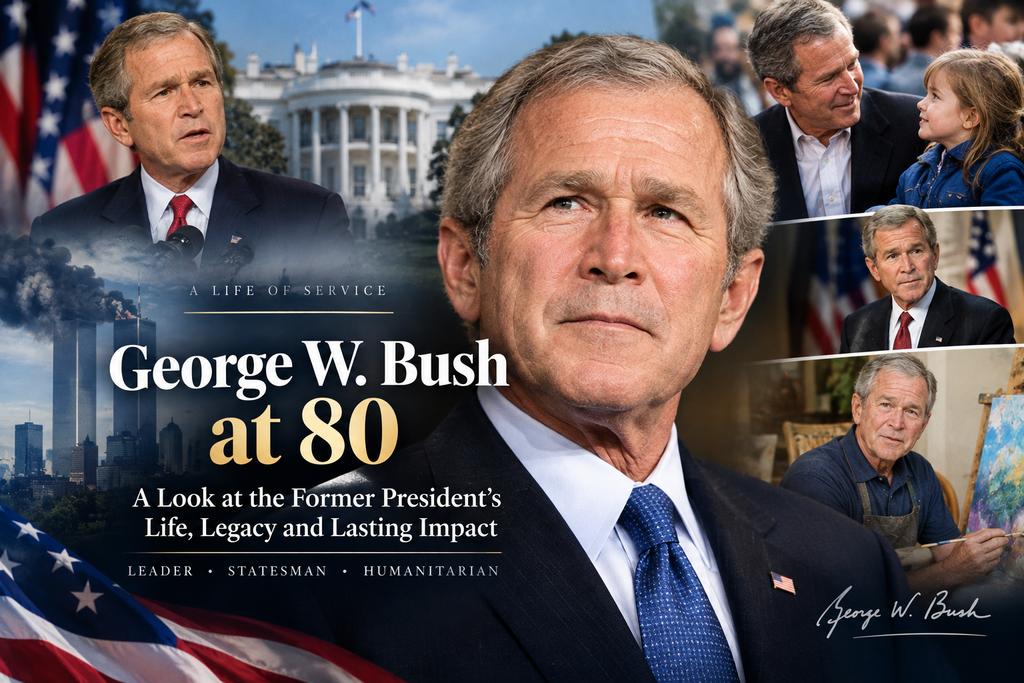
George W. Bush remains one of the most recognizable former presidents in modern American history.
As he reaches 80, renewed attention is being drawn to his presidency,
his post-White House work, and the lasting impact of some of the most important moments of his political career.
A President Who Led During a Defining Era
George W. Bush became the 43rd president of the United States in January 2001.
His presidency was quickly transformed by the September 11 terrorist attacks, an event
that dramatically changed American foreign policy and national security.
The attacks placed Bush at the center of one of the most difficult periods in modern U.S. history.
His administration responded with military operations in Afghanistan and later the invasion of Iraq, decisions that would remain subjects of intense political debate for years.
Life After the White House
After leaving office in January 2009, Bush largely stepped away from day-to-day partisan politics.
Instead, he devoted much of his time to the George W. Bush Presidential Center, humanitarian initiatives, veterans’ causes, and his growing interest in painting.
The Bush Center continues to focus on areas including democracy, education, economic opportunity, veterans and military families, and global health.
Remembering September 11
As the 25th anniversary of September 11 approaches, Bush has once again been connected to public events remembering the attacks and their impact on the United States.
The George W. Bush Presidential Center announced a special program featuring Bush alongside other figures to commemorate the anniversary.
The anniversary carries particular significance because Bush was president when the attacks occurred and became one of the central figures associated with America’s response.
His Political Legacy
Bush’s legacy remains complicated.
Supporters point to his leadership following September 11, his education initiatives, and programs such as PEPFAR, which became one of the most significant U.S. global health efforts.
Critics, meanwhile, continue to debate the Iraq War, the handling of national security policies, and other decisions made during his administration.
Decades later, historians and Americans continue to examine both sides of his presidency.
A Different Role Today
Today’s George W. Bush is very different from the president who once stood at the center of global politics.
His post-presidential life has included public speaking, charitable work, painting, and activities connected to his presidential center.
Recent reporting has also highlighted his distance from the current direction of the Republican Party. Bush has generally maintained a lower political profile rather than returning to the center of electoral politics.
Looking Back at an Extraordinary Chapter
Whether viewed positively or critically, George W. Bush’s place in American history is secure.
His presidency was shaped by war, terrorism, economic challenges, major political disagreements, and events that affected American society for decades.
At 80, his story is no longer primarily about holding political power. It is increasingly about reflecting on history, supporting causes he cares about, and preserving the record of an extraordinary period in American life.
Rather than focusing on an unverified death rumor circulating online, the more accurate story is about a former president who continues to participate in public and historical conversations.
George W. Bush’s presidency ended more than a decade ago, but the debates surrounding his decisions—and the events that defined his time in office—continue to shape how that era is remembered.