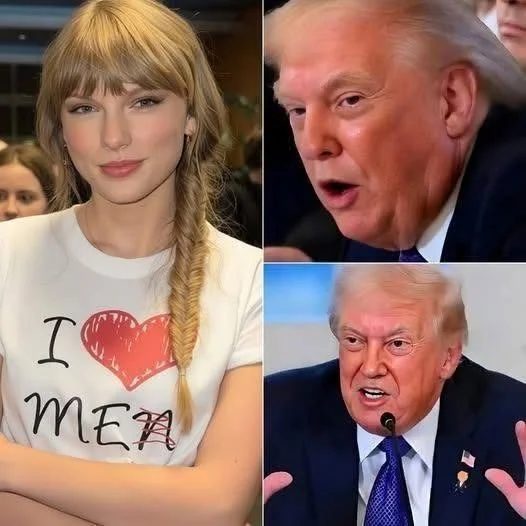
In this satirical scenario, Taylor Swift finds herself at the center of another fictional political storm after supposedly telling critics that she is not worried about losing fans simply because she chooses to speak her mind.
The imaginary statement comes as political arguments continue to dominate conversations across America,
with Swift portrayed as saying that upcoming public appearances would give her another opportunity to talk about the country’s growing divisions.
“I ain’t sweat’n losing fans,” the fictional Swift says in the satirical scenario. “People can disagree with me. That’s part of having a country where everyone gets to speak.”
The imagined comments quickly become the kind of internet moment that sends social media into overdrive.
Supporters celebrate the fictional message, critics accuse her of getting too political, and everyone else apparently reaches for their phones to see what happens next.
A Fictional Call for Common Sense
The satire imagines Swift emphasizing something broader than party politics: the idea that Americans should be able to disagree without turning every disagreement into a personal war.
In the fictional version of events, she argues that political leaders should be challenged when they encourage people to become angry at one another.
The imaginary speech also focuses on religion, portraying Swift as warning against politicians who use people’s faith as a tool for political division.
The fictional message is simple: faith should not become an excuse for hatred, and political disagreement should not automatically turn neighbors into enemies.
The Internet Predictably Explodes
Naturally, the fictional comments would not remain quiet for long.
Social media users in this satirical universe immediately split into competing camps. Some applaud the celebrity for refusing to remain silent, while others argue that entertainers should stay away from politics.
Memes appear. Comment sections become battlefields. Headlines multiply.
And somewhere in the middle of it all, ordinary Americans are left asking the same question: Can the country disagree without completely losing its sense of humor?
Fame, Fans and Free Speech
The satire also plays with the complicated relationship between celebrities and their audiences.
For a global superstar, expressing a political opinion can create both support and backlash.
Fans may disagree with an artist while continuing to enjoy their music, while others may decide that political disagreements change how they view a celebrity.
The fictional Swift’s response—“I ain’t sweat’n” losing fans—is therefore portrayed as a statement about accepting the consequences of speaking publicly.
Whether people agree with her imaginary position or not, the satirical story revolves around a recognizable question: Should celebrities remain silent simply because some fans might disagree with them?
A Country Divided
At the heart of the fictional story is America’s political polarization.
Democrats and Republicans frequently disagree about major issues, while political debates increasingly spill into entertainment, sports, social media and popular culture.
The satire exaggerates that reality by imagining Swift becoming one more unexpected voice in the national argument.
Instead of presenting her as having all the answers, the fictional scenario portrays her as calling for something much less dramatic: common sense, disagreement without hatred, and a little more willingness to listen.
The Punchline
And that may be the funniest part of the fictional story.
In an era when practically everything can become a political controversy, even saying “let’s calm down and use common sense” can apparently become headline material.
So, in this satirical version of events, Taylor Swift isn’t worried about pleasing everybody.
She’s supposedly ready to speak her mind, accept that some people won’t like it, and keep talking about America’s divisions.
Whether that would actually happen is another question entirely.
Again, this is satire. The quoted statements and scenario above are fictional and should not be treated as verified Taylor Swift remarks.