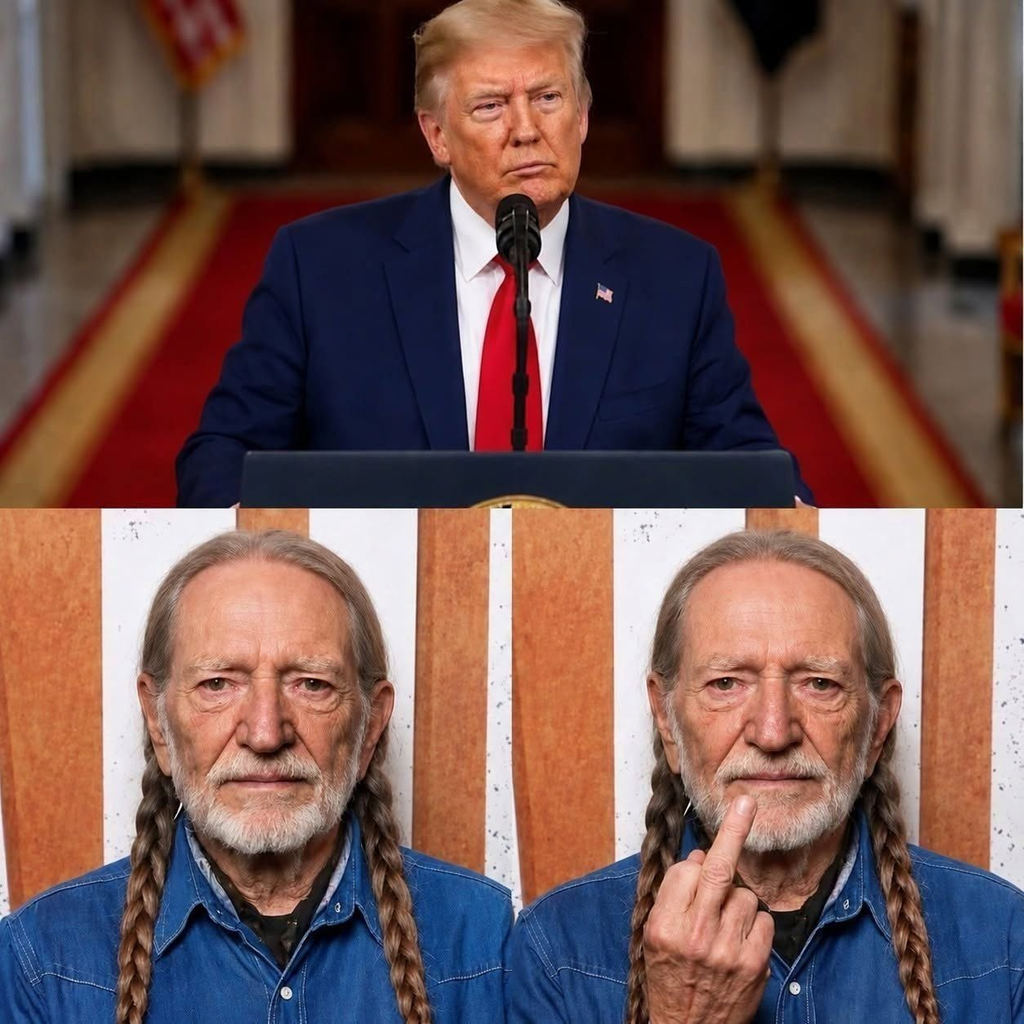
In the modern digital age, some stories do not begin on television.
They begin with a single sentence.A headline.A short video clip.
A dramatic caption.And before anyone has time to ask questions, millions of people are already talking.
That is exactly what happened when a sensational claim involving country music legend
Willie Nelson and former President Donald Trump began spreading across social media.
The story contained every ingredient that makes online audiences pay attention.A beloved cultural figure.
A powerful political personality.A prestigious university.
A mysterious document.And the promise of a shocking revelation that would supposedly change the way people viewed a familiar public image.
The narrative suggested that Willie Nelson had appeared in a dramatic television moment, presenting information connected to
Trump’s long-discussed claims about his intelligence and education at the Wharton School.The description sounded like something written for a television drama.
A calm introduction.A surprising discovery.A room becoming silent.
A public figure facing an unexpected challenge.And an explosive reaction afterward.
Millions of people shared the story because it felt like a historic moment.But the deeper story was not only about whether the event happened.
The deeper story was about why people are so drawn to moments like this.
Why do audiences love the idea of a famous person suddenly revealing hidden information?
Why do these stories spread faster than traditional news?
And why does the internet often transform a claim into a cultural event before anyone knows the full truth?
THE LONG HISTORY OF CELEBRITIES, POLITICS, AND PUBLIC IMAGE
For decades, America has been fascinated by the relationship between entertainment and politics.
Musicians, actors, and performers have often become part of larger cultural conversations.
Sometimes they speak about social issues.Sometimes they support political movements.
Sometimes they simply become symbols because of their personalities and careers.
Willie Nelson represents a unique place in American culture.
For more than half a century, he has been recognized not only for his music but also for his independent spirit and willingness to express personal views.
Donald Trump represents a different kind of public identity.
Before entering politics, he was known for business, television appearances, and a highly visible media presence.
After entering politics, his public image became one of the most discussed in modern American history.
When two recognizable names like these appear together in a dramatic story, attention naturally follows.People are curious.
They want to know what happened.
They want to understand the conflict.They want to see the moment everyone is talking about.
That curiosity is one of the strongest forces behind viral media.
Throughout history, people have been fascinated by hidden information.
Secret letters.Lost recordings.
Unknown photographs.Private documents.
The idea that one piece of evidence can suddenly change the public understanding of a famous person is one of the oldest storytelling techniques.
It appears in movies.It appears in documentaries.It appears in novels.
And now it appears constantly online.A mysterious document creates instant curiosity.People imagine:“What does it reveal?”
“Why was it hidden?”“Who knew about it?”“Why is it coming out now?”The problem is that the emotional power of a hidden document can sometimes become stronger than the evidence itself.
A document mentioned online can feel real before anyone actually sees it.A claim repeated thousands of times can feel confirmed even when it is not.
That is one of the greatest challenges of the internet era.
THE DIFFERENCE BETWEEN A GOOD STORY AND A TRUE STORY
A powerful storyteller understands emotion.A journalist must also understand verification.Those two things are not always the same.
A dramatic story may contain:A hero.
A conflict.A shocking discovery.A dramatic reaction.Those elements make people want to keep reading.But reality often requires patience.
Real investigations require documents.Real claims require sources.Real historical moments require evidence.
The challenge today is that social media rewards speed.The first version of a story often reaches millions before the more careful version arrives.
By then, many people have already formed an opinion.
Why do people share stories about shocking revelations?Psychologists who study information sharing often point to emotion as a major factor.
Content that creates strong feelings is more likely to be shared.Surprise.Anger.Excitement.A story suggesting that a famous person has been exposed naturally creates strong emotional reactions.
It gives audiences a feeling that they are discovering something important.
It creates a sense of being “inside” a major event.That feeling can be powerful.But emotion alone does not determine truth.
A story can be emotionally satisfying and still require verification.
Political information has a unique impact because it influences how people understand leaders, institutions, and public debates.
A false claim about entertainment may simply create confusion.A false political claim can affect public conversations.
That is why political stories require careful attention to evidence.People can have different opinions about politicians.They can disagree strongly.
But meaningful disagreement depends on a shared understanding of basic facts.Without that foundation, conversations become battles between competing stories rather than discussions about reality.
THE INTERNET AGE: WHEN EVERYONE BECOMES A PUBLISHER
In previous generations, major stories usually passed through newspapers, television networks, and professional editors.Today, anyone with a smartphone can publish information instantly.This has created incredible opportunities.Ordinary people can share important stories.Communities can organize quickly.
Hidden issues can receive attention.
But it has also created new challenges.
False information can travel at the same speed as true information.A carefully researched report and an unsupported rumor can appear next to each other in the same social media feed.The responsibility has shifted.Audiences now need stronger media literacy.They need to ask:
Where did this come from?
Who confirmed it?Is there original evidence?Are multiple reliable sources reporting the same thing?
Part of the reason this story attracted attention is because Willie Nelson’s name carries decades of cultural meaning.
He is not simply a singer.He represents a certain image of authenticity.A musician who built a career through individuality.
A performer whose identity has always been connected to independence and personal expression.When a person with that kind of reputation appears in a story, audiences naturally pay attention.The name itself creates interest.
That is the power of cultural icons.Their identities become larger than their careers.Donald Trump’s public image has also developed over many decades.
Before politics, he was known through business and television.During his political career, discussions about his personality, communication style, education, and public statements became frequent topics of media coverage.Supporters and critics often interpret his public image differently.
That division is part of why stories involving Trump often generate intense reactions.People approach the same information with different expectations.
Some look for confirmation.Others look for criticism.That environment can make sensational stories spread quickly.
WHAT THIS VIRAL MOMENT TEACHES US ABOUT MODERN MEDIA
The most important lesson from stories like this is not simply whether people believed them.It is understanding why they spread.Modern audiences live in a world where attention is constantly competing.
Thousands of messages appear every day.To stand out, content often becomes more dramatic.More emotional.More extreme.The result is a media environment where the most shocking version of a story can sometimes become the most visible version.
That does not mean audiences should stop enjoying interesting stories.It means curiosity should always be paired with caution.
Great storytelling has always mattered.Humans connect through stories.Stories preserve history.
Stories explain complex issues.Stories help people understand each other.But the strongest stories are not only emotionally powerful.They are also responsible.
The future of media will belong to creators who can capture attention while respecting accuracy.
Because audiences eventually remember more than the excitement of a headline.
They remember whether they could trust the person telling the story.The viral Willie Nelson–Wharton story became a fascinating example of the modern information age.
It showed how quickly a dramatic narrative can capture global attention.It showed how powerful celebrity and politics remain in shaping conversations.
And it showed why verification matters more than ever.
In a world where every phone can become a broadcasting station, the question is no longer only:“Can this story go viral?”
The more important question is:“Can this story stand the test of truth?”Because the most powerful stories are not the ones that disappear after the excitement fades.They are the ones that remain valuable because they are accurate, meaningful, and trustworthy.
And that is the difference between a moment that trends for a day…and a story that deserves to be remembered.