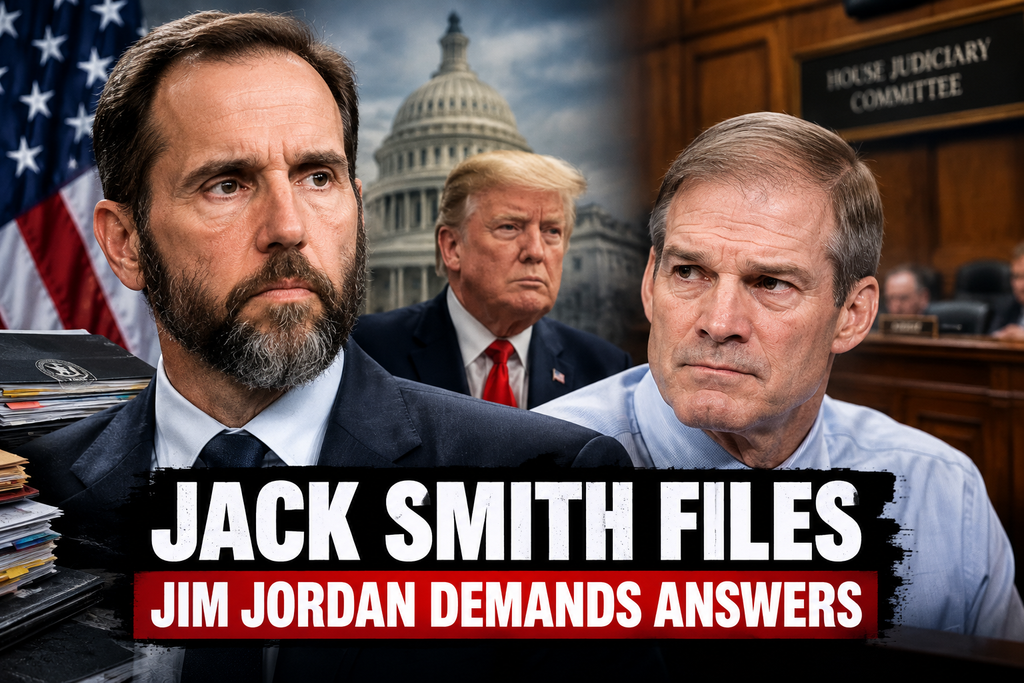
A new political fight over former Special Counsel Jack Smith’s investigation into
Donald Trump is putting Washington under renewed pressure, with House Judiciary Chairman
Jim Jordan demanding answers about records obtained during the investigation.
The controversy centers on newly released information concerning Smith’s investigative team and its handling of communications involving members of Congress.
In July, Jordan referred Smith to the Justice Department for possible prosecution, alleging that the former special counsel made false or misleading statements during congressional testimony.
Smith’s attorneys rejected the accusation and said he answered the questions truthfully.
Why the Smith Files Are Back in the Spotlight
The latest dispute is not simply about one document.
It has become part of a much larger political battle over how the Trump investigations were conducted and whether investigators followed the proper procedures.
Records released in July showed that Smith’s investigative team obtained text messages involving 44 members of Congress during the Trump investigation.
Senate Judiciary Chairman Chuck Grassley and Sen. Ron Johnson said the records raised serious questions about investigative procedures and constitutional protections.
Those revelations quickly became a major point of interest for congressional Republicans.
Jordan argued that the newly surfaced records conflicted with Smith’s previous testimony about what information his team had obtained.
His committee subsequently referred the matter to the Justice Department.
Jim Jordan Pushes for More Answers
Jordan has continued to make Smith-related investigations a priority for the House Judiciary Committee.
In July, his committee formally referred Smith to the DOJ, arguing that statements made during a December 2025 deposition appeared to be intentionally false.
The referral itself does not force the Justice Department to bring charges, but it escalated an already intense political dispute.
Smith’s attorneys strongly disputed Jordan’s interpretation, arguing that the former special counsel gave truthful and responsive answers to the questions he was asked.
That disagreement is now at the center of the controversy.
Trump Investigation Under Renewed Scrutiny
The dispute comes as Republicans continue examining the investigations that targeted Trump before and after his return to the White House.
Jordan has also pursued other FBI-related records. On September 2, 2026, he demanded additional documents concerning an FBI operation known as “Round River,” after declassified material raised questions about how certain Trump officials and political allies were classified during the 2020 election period.
Together, these investigations have created another wave of political confrontation in Washington.
Republicans argue that the public deserves greater transparency about how federal investigators handled politically sensitive cases.
Democrats and Smith’s defenders have pushed back against what they view as politically motivated attacks on law-enforcement officials.
What Happens Next?
The biggest question is whether the Justice Department will take further action based on Jordan’s referral.
A congressional criminal referral does not automatically result in prosecution.
The DOJ must independently determine whether there is sufficient evidence and whether any federal law was violated.
Reporting on the matter has emphasized that the department is not legally required to act on the referral.
For now, the controversy remains an ongoing political and legal battle rather than a final determination of wrongdoing.
As more documents become public, lawmakers on both sides are likely to continue examining the conduct of Smith’s investigative team, the treatment of congressional communications, and the broader question of how federal investigations involving Trump were conducted.
The latest developments ensure that the debate over Jack Smith’s investigations is far from over—and Washington is once again watching closely.