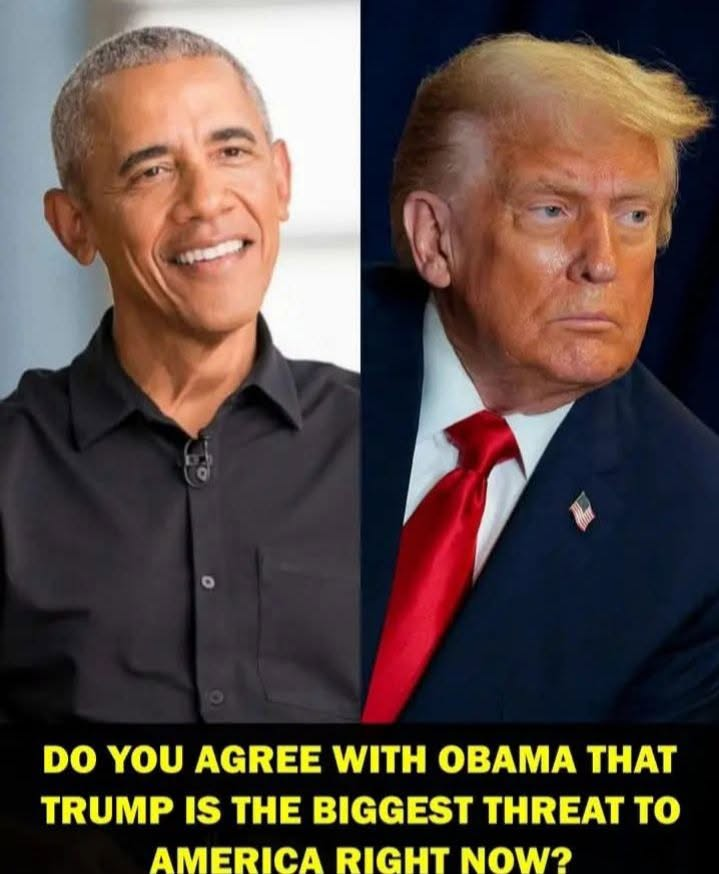
Obama’s Remarks on Trump Spark Fresh Debate Over America’s Biggest Threat
A viral claim about Barack Obama and Donald Trump is once again drawing intense attention online,
with social-media posts suggesting that the former president made a dramatic statement about what he considers the greatest threat facing America.
The claim has been presented alongside references to Islamophobia and jihadist violence, but the specific wording circulating online should be treated cautiously.
There is no reliable evidence confirming that Obama recently declared Donald Trump “the biggest threat to America today.”
What Obama Has Actually Said
Obama has spoken extensively about terrorism, extremism, Islamophobia and political rhetoric throughout his public career.
During a 2016 interview with CBS, Obama rejected the idea that the United States should respond to terrorism by targeting Muslims as a group.
He argued that violent extremist organizations should be confronted without allowing fear to divide American society.
Obama also explained why he avoided repeatedly using the phrase “radical Islam.”
His argument was that groups such as ISIS and al-Qaeda wanted the conflict to become a broader war between Islam and the West.
According to Obama, treating the fight as a battle against an entire religion could make the United States less effective in defeating violent extremist organizations.
Trump Was Part of That Debate
Donald Trump was already a central figure in the 2016 national-security debate when Obama made those comments.
Obama criticized proposals associated with Trump, including ideas involving religious restrictions on Muslims entering the United States.
He argued that such approaches could undermine American values and make it harder to build cooperation with Muslim communities and international allies.
The disagreement reflected a much larger argument over how America should respond to terrorism.
One side emphasized aggressive security policies and stronger restrictions.
The other warned that broad religious or ethnic targeting could create additional division while helping extremist propaganda.
Why the Claim Is Going Viral Again
The renewed attention comes at a particularly sensitive moment for discussions about terrorism and political extremism.
Twenty-five years after the September 11 attacks,
Americans continue to debate how the country should balance national security with civil liberties and religious freedom.
Recent polling reported by Reuters found that Americans now express greater concern about domestic extremism and random acts of violence than about foreign terrorism.
At the same time, debates surrounding Islamophobia remain politically significant.
Recent reporting has highlighted how Muslim Americans and Muslim political candidates have become increasingly prominent targets in the 2026 political environment.
That broader debate has created an environment where old political statements can quickly resurface and be presented as breaking news.
The Important Distinction
There is an important difference between Obama’s documented criticism of Trump’s political rhetoric and the viral claim that Obama has recently declared Trump to be America’s “biggest threat.”
The former is supported by historical interviews and official transcripts. The latter has not been independently established by reliable reporting.
That distinction matters because political clips and headlines can easily remove comments from their original context.
A statement made years ago can suddenly appear new when it is reposted with a dramatic headline.
A Debate That Continues
The underlying issue, however, remains highly relevant.
America continues to face threats from violent extremist organizations, domestic extremists and other forms of political violence.
At the same time, policymakers and civil-rights advocates continue to debate how those threats should be addressed without unfairly targeting entire religious or ethnic communities.
Obama’s earlier comments emphasized that distinction: the United States should fight violent extremism while avoiding policies that turn the conflict into a battle against an entire religion.
Whether Americans agree with that approach or not, the debate remains one of the most consequential questions surrounding national security and political leadership.
As viral posts continue circulating, readers should look beyond sensational headlines and check the original interview, date and context before accepting dramatic claims about what a former president actually said.