The photograph lasted only a moment.
A president sitting aboard Air Force One, looking down at a document.
But the image quickly became a symbol of a much larger fight —
a battle over a building, a name, and the meaning of a national institution that was created to represent something bigger than any individual.
The Kennedy Center, standing along the Potomac River in Washington, D.C., has always been more than a performing arts venue.
Since opening in 1971, it has served as a living memorial to President John F. Kennedy and as one of America’s most recognized cultural institutions.
For generations of artists, musicians, actors, and audiences, the building represented a promise: that art was not merely entertainment, but part of the nation’s identity.
Now, that symbol has become the center of a political and legal dispute involving President Donald Trump,
the Kennedy Center board, members of Congress, and some of the country’s most prominent artists.
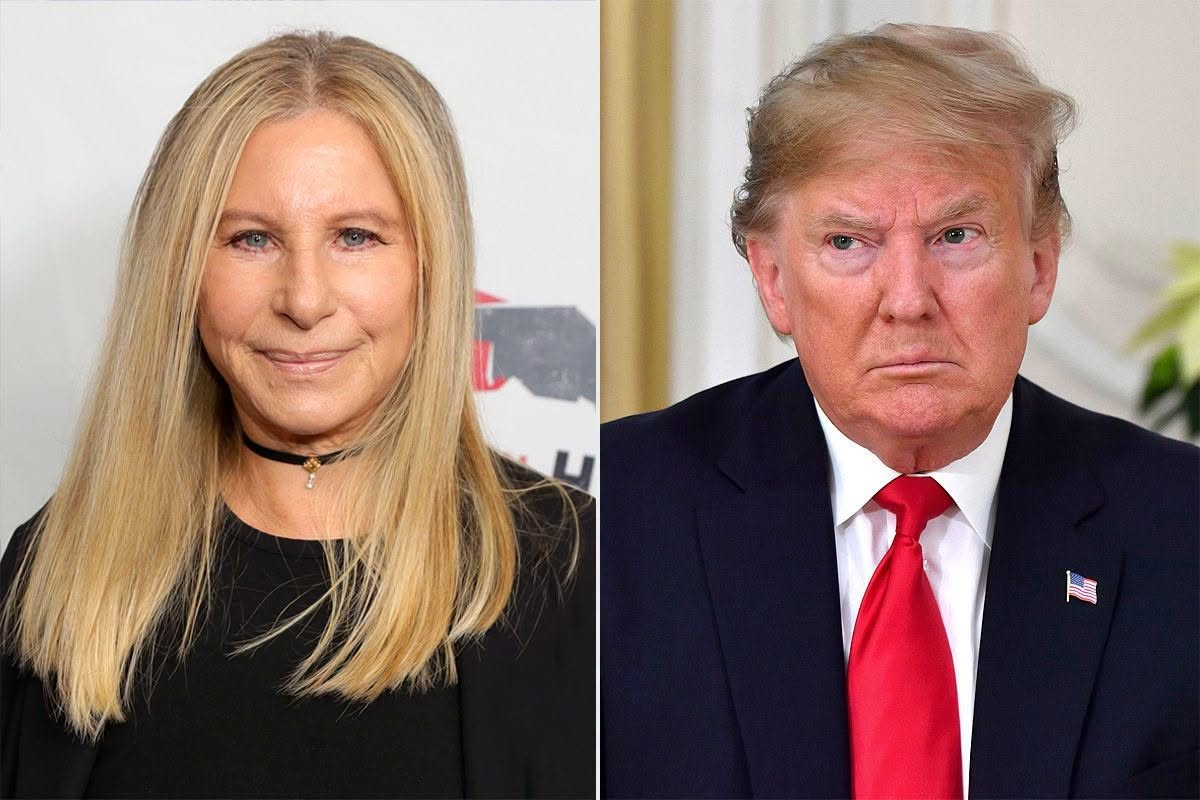
Among those speaking out was Barbra Streisand — one of the most celebrated performers of her generation
who described the controversy as painful to watch and connected it to a broader concern about the relationship between politics and cultural institutions.
Her comments transformed an already heated dispute into a national conversation:
Who owns America’s symbols?
Who has the authority to reshape them?
And what happens when a place created to honor history becomes the battlefield for a modern political struggle?
A Building Created To Remember A President
To understand why the Kennedy Center controversy has created such strong reactions, it is important to understand what the building represents.
The John F. Kennedy Center for the Performing Arts was established as a memorial following President Kennedy’s assassination in 1963.
The idea was not simply to build another theater.
It was to create a national home for the arts — a place where performances could bring Americans together regardless of political differences.
For many artists, receiving recognition connected to the Kennedy Center has carried a meaning beyond professional achievement.
Barbra Streisand herself became a Kennedy Center Honoree in 2008, an acknowledgment given to individuals whose contributions have shaped American culture.
In her statement, Streisand reflected on that honor as something larger than personal success.
For her, and for many artists, the Kennedy Center represented a belief that art plays a meaningful role in democratic society.
That belief is exactly why the current dispute has become so emotional.
To supporters of preserving the traditional identity of the institution, the center represents continuity and history.
To supporters of changes proposed by the current leadership, the focus is on renovation, recognition, and the future direction of the venue.
The disagreement is not only about a building.
It is about what that building means.
THE FIGHT OVER A NAME THAT TURNED INTO A NATIONAL CONTROVERSY
The controversy intensified after President Trump and his allies became involved in efforts surrounding the Kennedy Center’s leadership and branding.
Legal disputes followed over proposed changes connected to Trump’s name being added to the institution.
A federal judge later ruled that certain naming changes could not proceed without congressional authority, according to court records.
The disagreement created two very different interpretations of the situation.
Supporters of Trump’s position argued that his administration was attempting to restore and improve a major cultural institution, pointing to renovation needs and financial concerns.
Critics argued that placing a sitting president’s name on a memorial created for another president raised questions about tradition, authority, and the independence of cultural landmarks.
The debate quickly moved beyond architecture.
It became a discussion about memory.
About legacy.
About whether national institutions should remain symbols above political battles or whether leaders have the ability to reshape them.
BARBRA STREISAND ENTERS THE DEBATE
When Barbra Streisand spoke publicly, her words carried unusual weight because she was not simply commenting as a political observer.
She was speaking as an artist whose career had been deeply connected to the world the Kennedy Center was built to celebrate.
Her criticism focused on what she viewed as the danger of turning a cultural institution into a personal political symbol.
She described the situation as painful and expressed concern that a memorial created for President Kennedy had become caught in a dispute involving individual recognition and political power.
The phrase that attracted the most attention from her statement was her reference to “unchecked ego.”
Supporters of Streisand’s viewpoint saw her comments as a defense of cultural independence.
Those who disagreed argued that leaders have always influenced national institutions and that renovation and recognition efforts should not automatically be interpreted as personal ambition.
The disagreement reflected a larger divide in American public life:
Should national landmarks remain untouched symbols of history?
Or should they evolve with changing leadership and priorities?
THE DEMOLITION FEARS THAT ESCALATED THE CONFLICT
The dispute became even more intense after discussions about the future physical condition of the Kennedy Center.
Reports indicated that the center faced serious maintenance concerns, including structural issues that officials said required attention.
The Kennedy Center board approved plans involving a major renovation project, with officials citing the need to address problems at the aging facility.
But controversy increased after President Trump made comments suggesting the building could potentially be demolished if his preferred plans were not carried out.
A photograph showing Trump reviewing a document that appeared to include the words “Kennedy Center DEMOLISHED” intensified public concern.
The image itself did not establish what specific plan was being considered, who created the document, or whether full demolition was actually planned.
However, it became a powerful symbol in the ongoing debate.
Critics saw it as evidence that a national landmark was being placed at risk.
Officials involved in the project argued that renovation and safety concerns were central issues.
A federal judge later ordered that the administration provide at least 30 days’ notice before major physical changes, including potential demolition, and requested additional information about the closure and repair plans.
WHY THIS MOMENT MATTERS BEYOND THE KENNEDY CENTER
The Kennedy Center dispute represents something larger than a disagreement over one building.
Across the world, cultural institutions often become symbols of national identity.
Museums.
Libraries.
Historic buildings.
Memorials.
They preserve memories that belong to generations.
That is why changes involving these places often create emotional reactions.
A building can become a connection between past and present.
For some Americans, the Kennedy Center represents the legacy of John F. Kennedy and the belief that government can support culture and creativity.
For others, it represents an institution that must adapt, repair itself, and respond to new leadership.
Both sides are ultimately debating the same question:
What should a national symbol represent?
THE POWER OF ART IN TIMES OF POLITICAL DIVISION
Throughout American history, artists have often spoken during moments of political conflict.
Actors, musicians, writers, and performers have used their voices to discuss issues they believe affect society.
Barbra Streisand’s response fits into that long tradition.
Her message was not only about a building.
It was about the relationship between creativity and democracy.
Artists have long argued that culture provides a space where people with different backgrounds can share experiences.
A concert hall does not ask audiences to agree on every political issue.
A theater does not require everyone to have the same beliefs.
Instead, art creates a place where people can experience something together.
That is why many artists view cultural institutions as something that should rise above temporary political battles.
THE QUESTIONS THAT REMAIN
The future of the Kennedy Center remains tied to ongoing legal and administrative decisions.
Questions remain about renovation plans, leadership authority, funding, and the institution’s identity moving forward.
But beyond the legal arguments is a deeper question:
When a nation creates a memorial, who does it belong to?
A president?
A political party?
A generation?
Or the entire public?
The answer may determine not only what happens to one building in Washington, but how Americans think about the meaning of national institutions.
Because buildings are made of stone and steel.
But symbols are made of memory.
And once a symbol becomes part of a nation’s story, changing it can create a debate far larger than the walls that surround it.
A FINAL MESSAGE FROM THE KENNEDY CENTER CONTROVERSY
The fight surrounding the Kennedy Center reveals something important about American society.
People do not argue passionately about ordinary buildings.
They argue about places that carry meaning.
Places connected to history.
Places connected to identity.
Places that represent ideas bigger than themselves.
Whether someone views the controversy as a necessary modernization effort or as a threat to a historic institution often depends on their understanding of what the Kennedy Center should represent.
But one thing is clear:
The debate has reminded Americans that culture is never just about performances.
It is about memory.
It is about values.
It is about the stories a nation chooses to preserve.
And as Barbra Streisand’s comments showed, sometimes the most important battles are not fought over walls or names.
They are fought over what those walls and names mean.